Hua Hin Brings in Japanese Road-Safety Experts for a Pilot
Hua Hin Municipality, the town police and ThaiHealth met experts from Japan on 17 November to plan a road-safety pilot. Police say 34 people died on roads in the Hua Hin station area in 2025.

Thirty-four people died on the roads policed by Hua Hin police station in 2025. That figure, given on 17 November by the station’s superintendent, is the reason Hua Hin Municipality sat down that day with road-safety experts from Japan. The meeting took place in the Naresdamri room at the municipal office, and it was the preparatory meeting for what the town calls the Hua Hin Safety Ecosystem Sandbox.
A sandbox, in this sense, is a pilot area where a set of measures is tried together before anyone talks about copying them elsewhere. Mayor Nopporn Wuthikul chaired the session, according to MGR Online and 77 Kaoded. Both reports quote him on the aim: a town that can host visitors safely, which he describes as a “Hua Hin Smart Safety City”.
Who is in the room
The guest list is the most concrete part of the announcement. Two Japanese bodies took part: the Cabinet Office and the Japan Automobile Federation, the motoring organisation known as JAF. They shared what has worked in Japan, and the pilot draws on a research paper on how Japanese traffic discipline could shape safe-driving habits in Thailand.
On the Thai side, the meeting brought together the municipality, Hua Hin police, and ThaiHealth (the health promotion foundation, known in Thai as Sor Sor Sor). Officials from the highways bodies, schools, community groups and charitable foundations also attended. ThaiHealth sent the director of its bureau on social risk factors and the head of a project on driver awareness and safe-driving standards.
The mix matters because the mayor’s own framing is that no single measure works alone. His line, as reported, is that every component has to be connected and run in the same direction at once. In practice that means enforcement, road design, schools and community habits would be treated as one system.
The numbers behind it
Police gave two figures for 2025. The area covered by Hua Hin station (the municipality plus the Tap Tai and Hin Lek Fai subdistrict administrations) recorded 34 road deaths, a rate of 28.6 per 100,000 residents. Prachuap Khiri Khan as a whole recorded 34.93 per 100,000, which put the province 11th in the country. The first two numbers imply a resident population of roughly 119,000, which is our own arithmetic and does not count visitors or second-home owners.
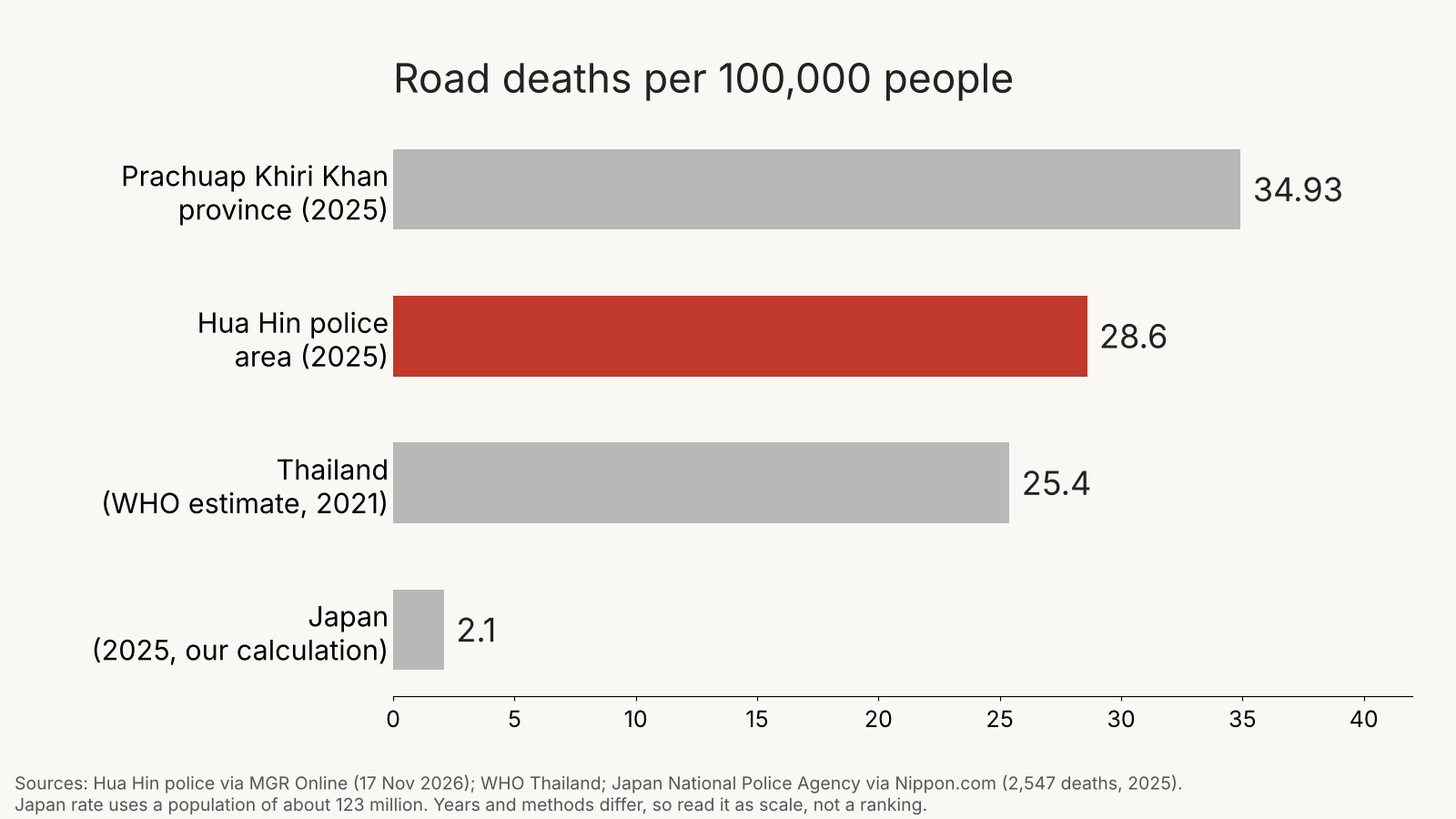 Chart: Hitkub. Hua Hin and provincial figures from Hua Hin police via MGR Online, 17 November 2026. Thailand from the WHO. Japan from the National Police Agency total reported by Nippon.com.
The comparison shows why Japan was invited. The World Health Organization estimates 18,218 road deaths in Thailand in 2021, about 50 a day, or 25.4 per 100,000 people. Japan’s National Police Agency counted 2,547 deaths in 2025, the lowest since records began in 1948 and 116 fewer than the year before. Dividing by a population of about 123 million gives roughly 2.1 per 100,000. The years and counting methods differ, so use the chart for scale rather than as a league table.
Japan is not a finished success story either. The same report says its total fell short of a government goal of fewer than 2,000 deaths by 2025. That is a useful caution for anyone expecting a quick fix from a pilot.
What happens next
Neither report gives a budget, a timetable or a list of specific measures. We cannot tell you yet whether the pilot means new speed enforcement, changes at particular junctions, school programmes or something else, because the sources describe the framework and not its contents. Nor is there an area boundary: the reports name the meeting and the partners, not the streets the pilot will cover.
For residents and weekenders, the practical effect today is nil. Nothing changes on the road because of Tuesday’s meeting. The thing to watch is the follow-up: whether the municipality publishes a plan with dates, which roads it names, and whether next year’s police figures move. We will update this story when any of that appears.
— End of article —