Overseas Online Orders Face Thai Import Duty of Up to 30%
Cabinet has approved duty of up to 30% on parcels bought from overseas platforms and shipped by courier or post. Which products jump, why now, and the three dates reports give for the start.
Anyone in Hua Hin who orders bags, jewellery or gym kit from an overseas platform is about to face a different bill at the door. On 10 November the Cabinet approved new import duty rules for parcels that arrive by express courier or international post. Duty will follow each product’s customs classification, with a ceiling of 30%, and nobody has yet confirmed the start date.
The headline number is easy to misread. The measure does not put 30% on every parcel. According to the Finance Ministry’s explanation, reported by Thai Publica, each product pays the statutory rate for its tariff line, capped at 30%. Where that rate was previously cut to a lower figure for parcels, it goes back up. Where the statutory rate is higher than 30%, the cap applies.
What changes, product by product
The Customs Department has not published a full schedule in anything we found. Thaiger lists four examples, and Thai Publica adds a fifth, so the table below is a sample rather than a price list.
| Product | Duty now | Duty under the new rules |
|---|---|---|
| Plastic products | 10% | 30% |
| Exercise equipment | 10% | 30% |
| Jewellery | 0% | 30% |
| Spectacles | 5% | 30% |
| Bags | 20% | 30% |
| Clothing | 30% | 30% (unchanged) |
Our arithmetic shows what that means at the checkout. A bag declared at ฿2,000 pays ฿400 in duty today and ฿600 under the new rules, before VAT and shipping. Jewellery declared at the same value would go from no duty to ฿600. Customs director-general Phantong Loykulnanta says platforms should be able to absorb part of the increase without sharply raising prices. That is an official expectation, and no independent estimate of how much sellers will absorb has been published.
Why the government is doing it
The ministry gives two reasons. The first is competition: Thai shops carry tax, wages and product-standard costs that overseas sellers shipping direct do not. The second is safety, with food, cosmetics, supplements, power banks and car parts named as categories where cheap imports may fail Thai standards. The Nation reports Finance Minister Ekniti Nitithanprapas saying the aim is not to close off online trade or restrict consumer choice.
Volume is the third reason, and the numbers are steep. Parcels arriving from abroad rose from 134.1 million in fiscal 2024 to 168.4 million in fiscal 2025, and Customs forecasts 241 million this year. Thaiger quotes Phantong saying the department does not have enough officers to inspect that many parcels, and that false declarations remain a problem.
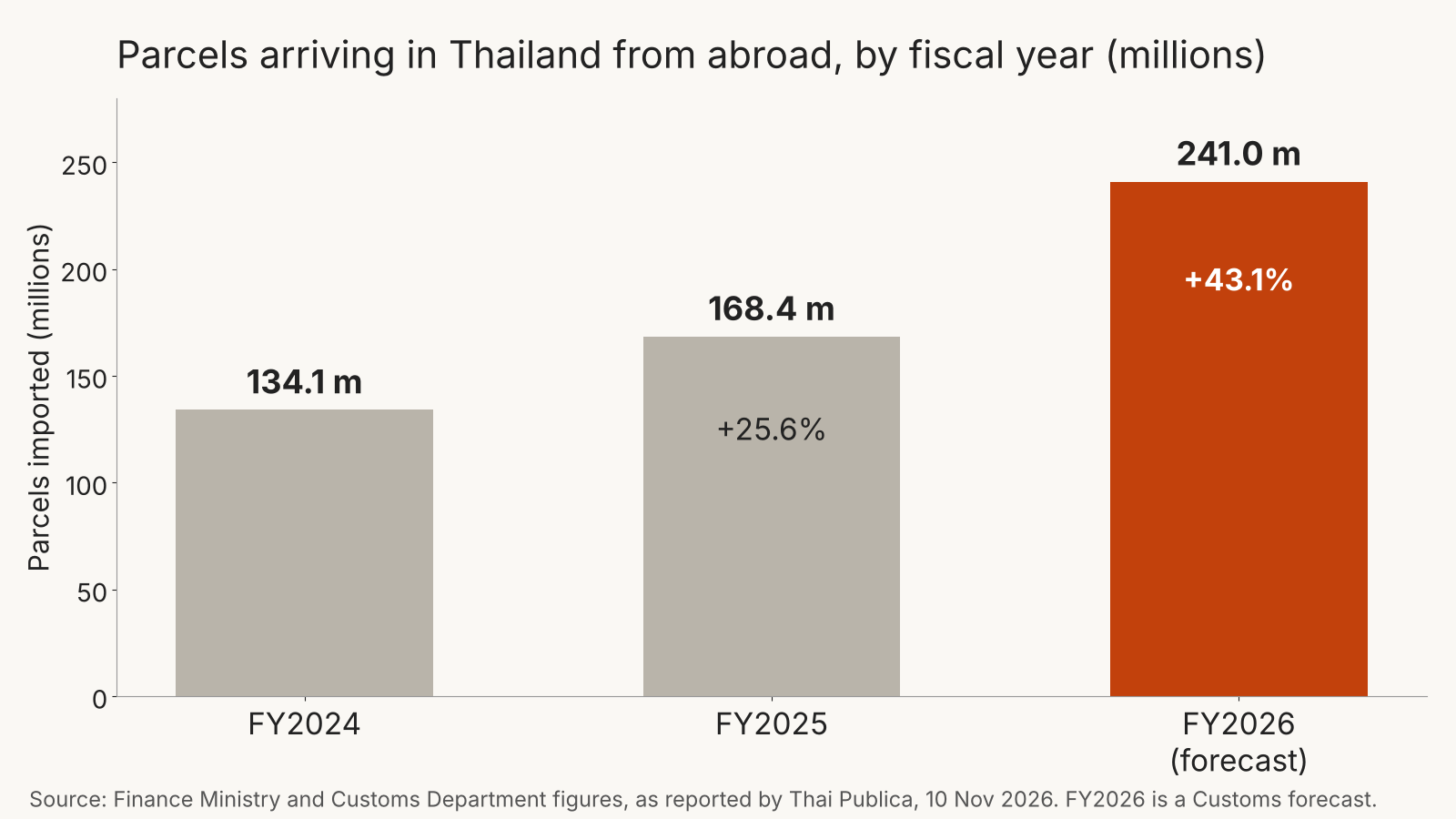 Chart: Hitkub. Data from the Finance Ministry and Customs Department as reported by Thai Publica, 10 November 2026.
The revenue case is just as plain. The ministry expects about ฿519.67 million more a month, or ฿6,236 million a year. Thaiger puts the same shift as duty revenue rising from ฿4.8 billion to roughly ฿11 billion, excluding VAT. The Trade Policy and Strategy Office estimates the affected goods make up only about 0.70% of the consumer price index basket, so the effect on overall inflation should be small. For a household ordering regularly from abroad, that average will matter less than the specific product.
When it starts
Three versions are in circulation. The Nation says the rules take effect the day after publication in the Royal Gazette. The ministry release carried by Thai Publica says 15 days after publication. Thaiger quotes Phantong expecting the start around 1 January 2027, depending on when the notice is published. None of the reports we read says the notice has appeared yet, so the Royal Gazette is the date to watch.
No source says whether parcels already in transit when the rules start will pay the old or the new rate. Anyone planning a large overseas order should wait for the Gazette notice before assuming either. The Finance Ministry and Customs say they will work with e-commerce platforms to prepare systems before the start, and Customs will use platform data to check declarations. How that will show up at checkout, and whether the duty is added to the price or collected on delivery, has not been described.
— End of article —