Thailand Flags 1,932 Firms for Nominee Checks, Ten in Prachuap
The Department of Business Development has flagged 1,932 companies run with naturalised foreigners as high risk for nominee use. Prachuap Khiri Khan, the province that includes Hua Hin, accounts for 10.
Of the 1,932 companies that Thailand’s Department of Business Development (DBD) now calls high risk for illegal nominee ownership, ten are registered in Prachuap Khiri Khan, the province that includes Hua Hin. Chonburi, home to Pattaya, has 347. The gap matters for anyone buying a Hua Hin villa or condo through a company, because it shows where the Commerce Ministry is looking first, and it is not here. The department did not break the Prachuap figure down by district, so we cannot say how many sit in Hua Hin itself.
A new target: naturalised owners
This round of checks is not about Thai friends and relatives who lend their names to foreign buyers. That was the pattern behind August’s search of pool villas in Thap Tai, Hua Hin, reported by The Nation. This time the focus is on foreigners who have become Thai citizens and now hold shares or directorships. DBD says nominee arrangements are growing more complex, with naturalised foreigners increasingly used as shareholders or directors of foreign-run businesses to avoid scrutiny.
Its analytics system, IBAS, found 12,421 naturalised citizens, identifiable by national ID numbers beginning with 8, holding shares or directorships in 16,504 active limited companies, The Nation reports. Of those, 1,932 are flagged high risk, linked to 1,632 people. That is about 12 percent of the 16,504, and a sliver of the 818,654 limited companies on the register, according to Thai PBS. DBD stressed that being flagged does not mean the individuals have committed an offence. Thai PBS reports that most of those involved are former Chinese, British, American, Pakistani or Israeli nationals.
The shape of the flagged firms is telling. Only 164 are wholly Thai-owned. The other 1,768 have foreign shareholders holding between 0.01 and 49.99 percent, the band just under the 50 percent mark at which a company stops counting as Thai.
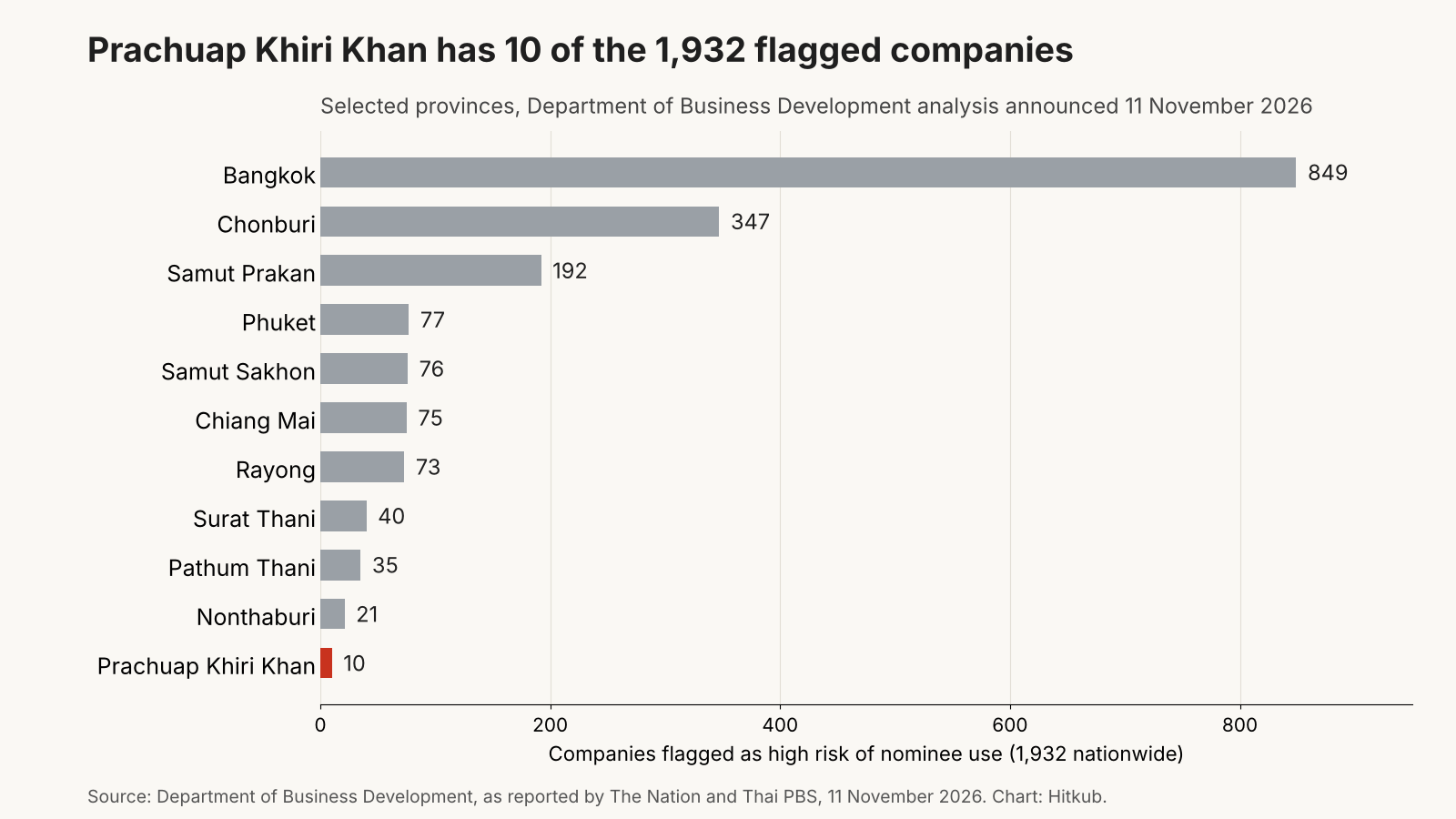 Chart: Hitkub. Data from the Department of Business Development, reported by The Nation and Thai PBS on 11 November 2026. Selected provinces shown; the full list also includes Chiang Rai (10), Mae Hong Son (3), Krabi (1) and Phang Nga (1).
Which businesses, and where
Property is prominent. Companies buying and selling non-residential property number 161, construction of non-residential buildings 83, residential property trading 67, real estate agencies and brokers 61, and residential rentals 44. Add them up and property trading, brokerage and rental account for 333 of the 1,932, about 17 percent. Restaurants are next to them at 63, which is a reminder for Hua Hin’s café and bar owners that the checks reach beyond land.
| Sector (flagged firms) | Companies |
|---|---|
| Buying and selling non-residential property | 161 |
| Non-residential building construction | 83 |
| Buying and selling residential property | 67 |
| Restaurants and food service | 63 |
| Real estate agencies and brokers | 61 |
| Renting and operating residential property | 44 |
Geography is lopsided. Bangkok has 849, Samut Prakan 192 and Chonburi 347, so the checks lean towards the capital and the eastern seaboard. Phuket has 77 and Chiang Mai 75. Prachuap’s ten is the same as Chiang Rai’s.
What it means for a Hua Hin buyer
Nothing in the announcement changes the rules for an ordinary foreign buyer. A foreign national can still own condo units within the 49 percent foreign quota, or hold a registered lease. The department’s warning is aimed at structures that hide who really owns and runs a business. The line it draws is plain: shareholding and management must reflect the real arrangement.
What does change is the likelihood of a knock on the door. DBD says it has discussed the findings with law enforcement agencies and is preparing in-depth on-site inspections, with no dates given. Offenders face penalties under the laws of the agencies involved, and naturalised citizens could also lose their Thai citizenship. That adds to the national drive we covered when the prime minister ordered probes finished by December, now tracked on our running timeline.
Anyone with questions about a company structure should ask a Thai-qualified lawyer, which this report is not a substitute for. DBD runs a nominee tip-off section at dbd.go.th and a call centre on 1570. The next date to watch is 31 December, the target the prime minister gave for finishing the highest-risk cases.
— End of article —