Thailand’s Land Nominee Crackdown: What It Means for Hua Hin Buyers
Police searched 15 pool-villa sites in Thap Tai in August, and on 19 October the prime minister gave governors until December to finish nominee cases nationwide. What is new, who is exposed, and which routes to owning in Hua Hin stay open.
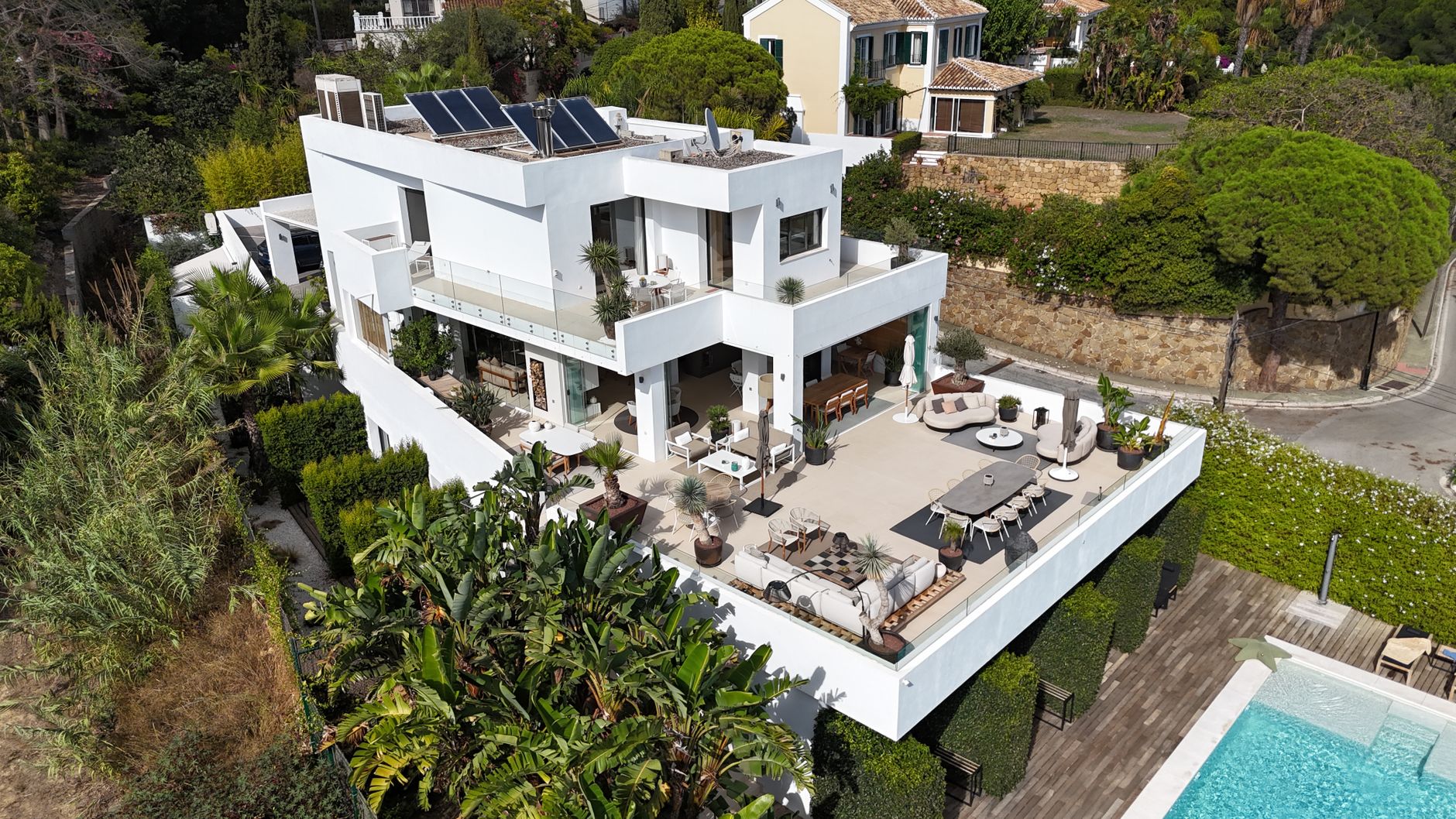
On 10 August, more than 200 police officers and officials searched 15 sites in Thap Tai, the inland subdistrict south-west of Hua Hin town. The targets were detached houses and pool villas priced at roughly ฿10–20 million each. Police said they were looking at 33 companies suspected of holding Hua Hin property for foreigners. That raid was the sixth phase of a national operation, and the prime minister has now given it a deadline.
On 19 October, Anutin Charnvirakul ordered provincial governors and the Department of Lands to bring their high-risk nominee cases to a conclusion by December, The Nation reports. Nothing in the law has changed. What has changed is the timetable, the scale and the paperwork buyers will meet at the land office.
What was ordered on 19 October
The order has three parts. Investigators must look past the names on title deeds and share registers to whoever controls and benefits from the land, including the money trail. Land found to be held unlawfully is to be sold compulsorily, with checks on the next buyer so that a plot does not simply pass from one nominee to another. And the Department of Lands is to tighten checks before and after registration, take public tip-offs and publish results, according to The Nation.
Officials also named the consequences they have in mind: revocation of land rights, deportation of foreigners deemed undesirable, and in some cases proceedings over Thai citizenship. A law firm that advises foreign buyers, GPS Legal, notes that deportation is not automatic and depends on the legal conditions or a court ruling. Anutin also said legitimate foreign investment remains welcome. The Commerce Ministry reported 971 foreign business approvals in the first nine months of 2026, up 26 percent on a year earlier, Hua Hin Localplus reports.
The Department of Lands gave the numbers behind the order, Bangkok Biz News reports:
| Step | Count |
|---|---|
| Companies holding land that were screened nationwide | 157,659 |
| Flagged as possible risks in the first pass | 14,151 |
| Left after removing Board of Investment-promoted firms | 13,088 |
| Foreign share above the legal limit (forced sale) | 1,550 |
| Suspected of holding land for foreigners | 11,538 |
| Already found holding land for foreigners | 1,397 companies, 2,360 plots, 5,467 rai, ฿14.01 billion |
Hua Hin has already had its raid
The Thap Tai search targeted one development, and police found six companies there that they allege used Thai nominee shareholders: four linked to its first phase and two to its second, The Nation reported at the time. Courts had issued arrest warrants for 45 foreigners and police summoned 39 Thai nationals. Thirteen foreigners were arrested, The Nation says, while MGR Online counts 12 arrested under warrants. Police said the suspects had not been charged in court.
The statements police described are worth reading closely, because they show what an investigator looks for. Foreigners told police they had been advised by law and accounting firms to set up companies and believed the arrangement was legal. Thai shareholders said they had agreed to hold shares but never paid for them or helped run the companies. Police said the companies carried out no real business. The advisers were not named.
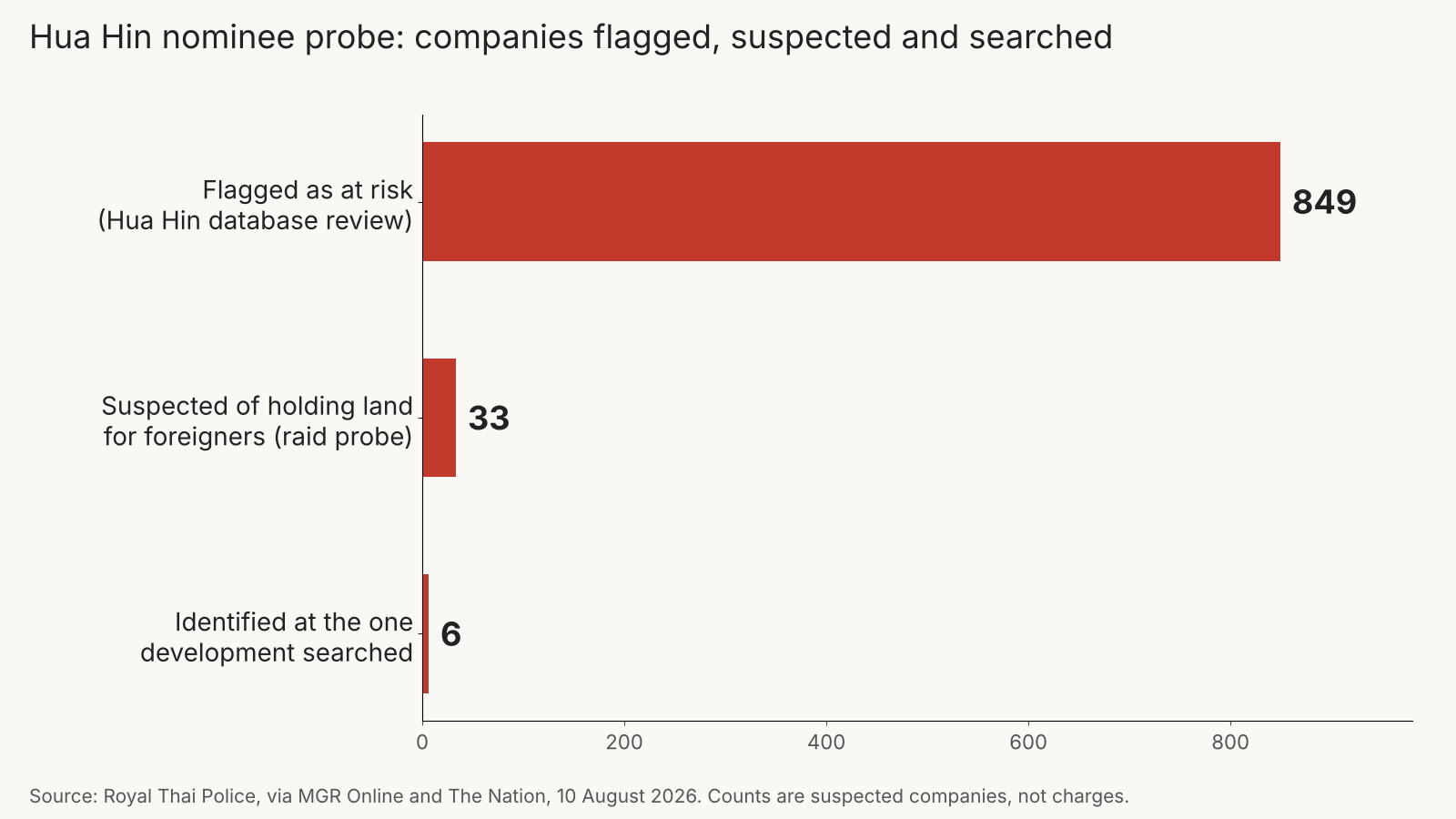 Chart: Hitkub. Figures from the Royal Thai Police as reported by MGR Online and The Nation, 10 August 2026. The counts are suspected companies, not charges.
The wider figure is the one for residents to note. A review of the corporate database in Hua Hin flagged 849 entities as at risk, MGR Online reports, and police said those would be examined in more depth. The 33 companies in the raid probe, tied to property valued at about ฿300 million, are a small slice of that pool. How many of the 849 will become cases is not public.
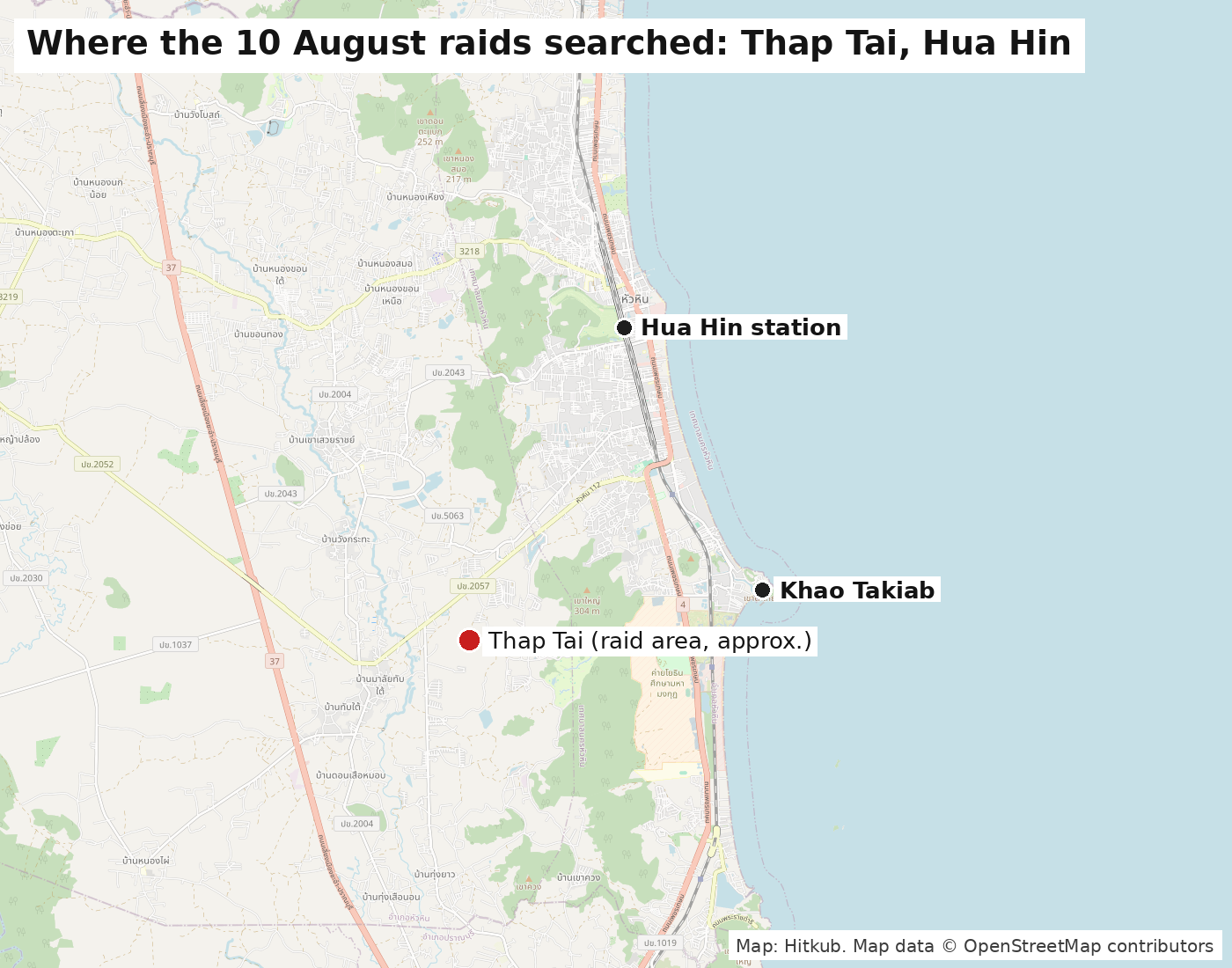 Map: Hitkub. Map data © OpenStreetMap contributors. The raids were reported at subdistrict level, so the Thap Tai marker is approximate.
Who is exposed, and who is not
The legal test is not complicated. A company counts as foreign for land purposes if foreigners hold more than 49 percent of its shares or make up more than half its shareholders, GPS Legal explains. Land held in breach can be ordered sold. The Foreign Business Act adds prison terms of up to three years and fines of ฿100,000 to ฿1 million for those who hold shares for foreigners to evade it. GPS Legal sells advice on these structures, so treat its commentary as a summary of the statutes rather than a neutral view.
The people with most reason to worry control a Thai land-holding company through Thai shareholders who did not invest their own money. GPS Legal adds Thai spouses of foreigners who cannot show the land was paid for with their own funds. Thansettakij reports that the Department of Lands wrote urgently to every governor asking for extra care in tourist areas and in places where foreign capital buys heavily. Hua Hin fits both descriptions.
The routes that stay open are the familiar ones, as GPS Legal lists them:
| Route | What the law allows |
|---|---|
| Condominium unit | Freehold, within the 49 percent foreign quota for each building, paid with funds brought in from abroad |
| Registered lease | Typically up to 30 years, with renewal terms drafted carefully |
| Usufruct, superficies, habitation | Rights registered against a title deed |
| Board of Investment-promoted company | May own land for its approved activities |
| Thai-majority company | Only with real Thai investors and a real business |
What buyers are asking
Will a condo purchase be caught? Nothing in the reports suggests a freehold condo within the quota is a target, and the order is aimed at circumvention, not foreign ownership as such. The enhanced checks described so far apply to land transactions, and the reports do not say whether condo transfers get the same treatment.
Will buying get slower? Thai Examiner reports that purchases above ฿2 million, or with an assessed value above ฿5 million, now draw questions about the source of the money and the buyer’s occupation. The two thresholds apply independently. That would include the ฿10–20 million villas police described in Thap Tai. In August, unnamed property-sector sources told The Nation that tighter scrutiny was slowing transfers in a luxury market that leans on foreign buyers in Bangkok, Pattaya and Phuket. They said it also created uncertainty for some legitimate buyers. No Hua Hin figures have been published.
What does it cost to check your position? No source gives a price. GPS Legal suggests an independent review of shareholdings, capital contributions and any side agreements, and says owners should avoid hurried restructuring. This is general information, not legal advice; a Thai-licensed lawyer can review a specific structure.
The next date to watch is December, when governors are due to finish their priority cases. No source has yet said when compulsory sales would begin or how many Hua Hin cases are among the priorities.
— End of article —